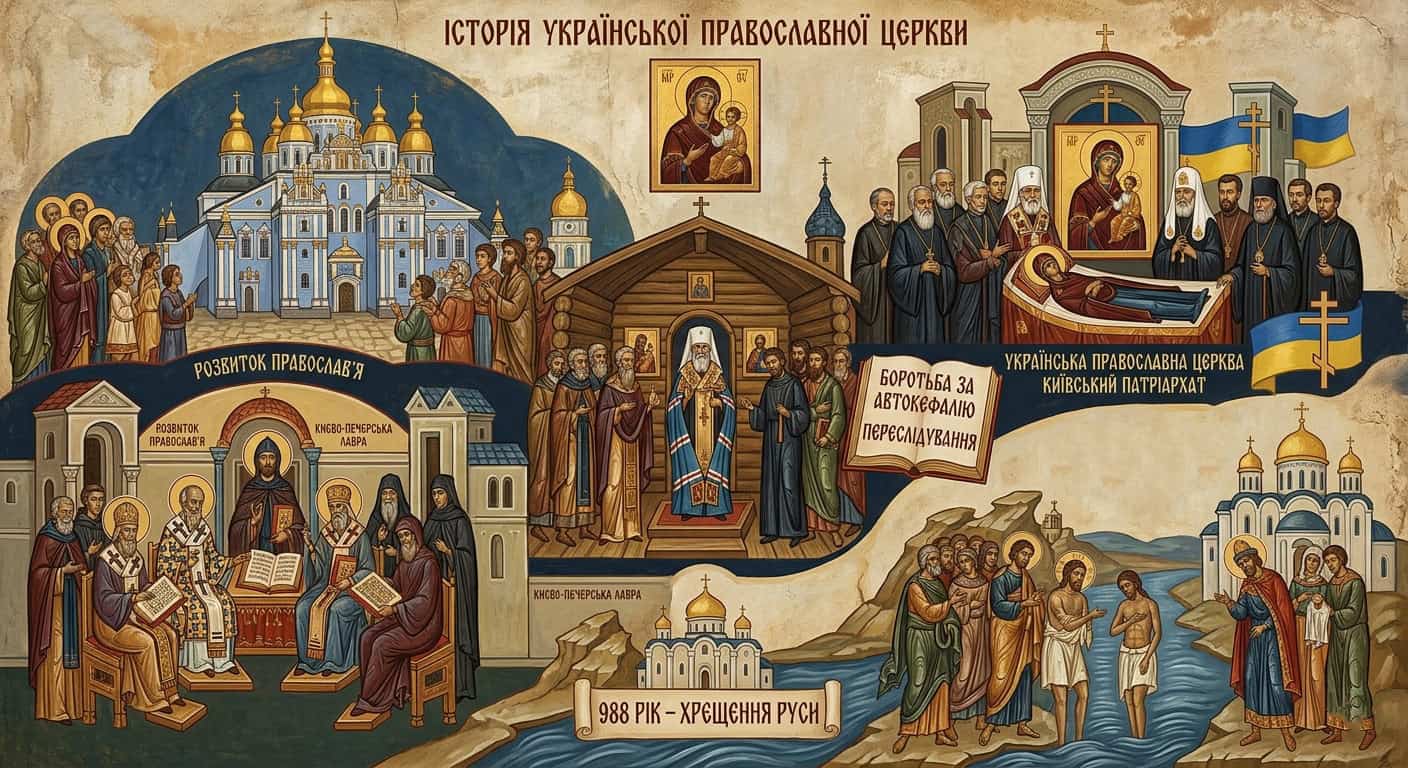
(A Brief Historical Outline)
1) The first Gospel proclamation on Ukrainian lands
The preaching of St. Andrew the First-Called on the lands of today’s Ukraine is remembered as the first proclamation of the Holy Gospel-the first Word of Christ addressed to the ancestors of modern Ukrainians. Christianity also spread through the Greek colonies in southern Ukraine, where the earliest Christian dioceses existed in the Northern Black Sea region and Crimea. A tremendous contribution to the development of Orthodox worship among the Slavic peoples in the 9th century came through the missionary labors of the holy Equal-to-the-Apostles Cyril and Methodius.
2) The baptism of Kyivan Rus’ and the role of Constantinople
Christianity took root in Kyivan Rus’ during the reigns of St. Askold (†882), Oleg (†912), and Igor (†945). St. Olga (†969), the Equal-to-the-Apostles Princess of Kyiv, was baptized in Constantinople; she built churches and supported the spread of the Christian faith throughout the state.
A decisive turning point came in 988, when St. Volodymyr (Vladimir) Sviatoslavych (963-1015) baptized Rus’-Ukraine, as recorded in the Primary Chronicle (Tale of Bygone Years). From that time, Kyivan Rus’-Ukraine was regarded as a Christian state in which the Orthodox Church held public, state-level significance. Because Orthodoxy came from Byzantium, the Ecumenical Patriarchate of Constantinople is understood as the Mother Church of the Orthodox Church of Ukraine.
3) The Kyivan Metropolia in the 10th-13th centuries: growth and flourishing
The Kyivan Metropolia was established in the early 990s. According to Church tradition, its first metropolitan was St. Michael of Kyiv (†992). Beginning in the 10th century, the organization of ecclesial life within the Metropolia gradually took shape. Under St. Yaroslav the Wise (978-1054), in 1051, Metropolitan Hilarion of Kyiv and All Rus’-author of “Sermon on Law and Grace”-was installed in Saint Sophia Cathedral.
During the Kyivan state period, new areas of Church life developed. Canonical and legal collections such as the Nomocanon and Kormchaia (Pilot) Books appeared, internal Church law advanced, and the Kyivan metropolitans exercised substantial canonical authority. Following the Byzantine model, relations between Church and state were grounded in the principle of “symphonia” (harmonious cooperation).
Church architecture and sacred art flourished. Great Orthodox temples were built, including the Tithe Church, Saint Sophia Cathedral, and the St. Michael’s Golden-Domed Monastery, among others. Monastic life in Rus’-Ukraine was founded by Sts. Anthony and Theodosius, who established the Kyivan Caves Monastery (Kyivo-Pecherska Lavra). In the pre-Mongol era, Kyivan saints were canonized, including the passion-bearer martyrs Princes Borys and Hlib and others.
The adoption of Christianity also spurred the rapid growth of Church learning and book culture. Yaroslav the Wise founded a library and school at Saint Sophia, while Church literacy, chronicle-writing, and preaching expanded.
4) The Kyivan Metropolia under the Lithuanian-Rus’ state (13th-15th centuries)
The gradual disintegration of the Kyivan state coincided with the rise of a new political center: the Vladimir-Suzdal Principality. After an unsuccessful attempt by Prince Andrei Bogolyubsky (1110-1174) to secure Constantinople’s blessing for a separate Vladimir metropolia in 1162, he attacked Kyiv in 1169, thoroughly plundered the city, and burned the Caves Monastery and Saint Sophia Cathedral.
The decline of the Kyivan state was intensified by the Mongol-Tatar assault on Kyiv on December 6, 1240. These events led to the transfer of the metropolitan seat from Kyiv to northern territories-despite the fact that such a move contradicted canonical norms. In the 13th century, the Kyivan Metropolia entered a period of fragmentation and weakening, accompanied by repeated attempts to establish a separate Halych (Galician) Metropolia in western Ukrainian lands.
Under Metropolitans Peter of Ratno (†1326) and Theognostus (†1353), the metropolitan residence was effectively moved to Moscow, contributing to Moscow’s rise as a significant ecclesial and political center.
5) The division of the Metropolia into Kyivan and Moscow jurisdictions
In the 14th century, the Grand Duchy of Lithuania expanded to include major portions of the former Kyivan realm. During the reign of Grand Duke Algirdas (1345-1377), rivalry between Moscow and the Kyivan center intensified over the Kyivan metropolitan throne and the title “Metropolitan of Kyiv and All Rus’.”
Under Grand Duke Vytautas (1392-1430), the Kyivan Metropolia again moved toward shaping a Ukrainian Church for Slavic lands outside Moscow’s political and ecclesial influence, even as Moscow-based hierarchs still retained the Kyivan title. In 1415, a council was convened in Novogrudok (the new seat within the Lithuanian realm), and Gregory Tsamblak (†1419) was elected Metropolitan of Kyiv.
The final division of the Kyivan Metropolia into two distinct metropolias-Kyiv and Moscow-occurred in the era of Metropolitan Isidore (†1463). This was driven by the Council of Ferrara-Florence (the union efforts) and by the fall of Constantinople in 1453, after which the city became the Ottoman capital (Istanbul). In Moscow, a separate metropolitan was installed, and in 1448 Moscow effectively proclaimed autocephaly. Meanwhile, Gregory II Bulgarinovich (1458-1473) became Metropolitan of Kyiv, Halych, and All Rus’. This period marks the beginning of the formation of distinct national Orthodox traditions-Ukrainian and Russian.
6) The Kyivan Metropolia in the Polish-Lithuanian Commonwealth (15th-17th centuries)
After Moscow’s definitive separation, the Ukrainian Orthodox Church (the Kyivan Metropolia) continued to exist independently within the Polish-Lithuanian state. From the second half of the 15th century, Kyivan metropolitans were elected locally and then confirmed by the Patriarchs of Constantinople. Among the most prominent canonized saints of this period is the hieromartyr Metropolitan Macarius (†1497).
Throughout the 16th century, Church councils were convened to address ecclesial challenges. Early in the century, fewer councils are recorded (for example, the Vilnius regional council of 1509), but as internal tensions grew, the number of councils increased significantly in the later 16th century. The culminating event was the Council of Brest (1596), after which the Kyivan Metropolia definitively split into Orthodox and Uniate branches.
In this era, Orthodox brotherhoods became highly active-most notably the Lviv and Vilnius братства (brotherhoods). In the late 16th century, Prince Vasyl-Kostiantyn Ostrozky (1527-1608) founded the Ostroh Academy, where the Ostroh Bible (1581) was published. Ukrainian theology developed through polemical writings by Ivan Vyshensky, Vasyl Surazky, Herasym Smotrytsky, and others.
7) The Union of Brest and the restoration of the Orthodox hierarchy (1595-1620)
During the reign of King Sigismund III Vasa (1536-1632), a church union with Rome was concluded in December 1595. In Brest in 1596, Orthodox and Latin-Uniate councils took place simultaneously, and their decisions solidified the split of the Kyivan Metropolia.
Ukrainian Cossacks, led by Hetman Petro Konashevych-Sahaidachny, joined the defense of Orthodoxy and supported the Kyiv Epiphany Brotherhood, founded in 1615. Under pressure and persecution in the Commonwealth, the Orthodox hierarchy was restored in 1620 by Theophanes III, Patriarch of Jerusalem (†1644), who consecrated Job Boretsky as Metropolitan of Kyiv.
8) Metropolitan Petro Mohyla and the Khmelnytsky era
St. Petro Mohyla (1632-1647) assumed the Kyivan metropolitan throne amid severe internal religious and political conflict. To reduce hostility and stabilize relations, the “Articles of Pacification” (1632) were adopted, by which state authorities recognized the Orthodox Kyivan Metropolia. Mohyla’s efforts were aimed at restoring Church life and founding the Kyiv-Mohyla Collegium to strengthen Orthodox education and theology.
Kyivan metropolitans of the late 17th century served during the Khmelnytsky period and tried to preserve the Kyivan Metropolia’s canonical unity with Constantinople on Right-Bank Ukraine: Sylvester Kosiv (†1657), Dionysius Balaban (†1663), and Joseph Neliubovych-Tukalsky (†1676). The Pereiaslav Agreement of 1654 intensified Moscow’s attempts-both governmental and ecclesiastical-to place the Kyivan Metropolia under its control. On Left-Bank Ukraine, the metropolitan throne was administered by locum tenens figures such as Archbishop Lazar Baranovych of Chernihiv and Bishop Methodius Fylymonovych.
9) The synodal period (1686-1721-1917): restriction and russification
After the uncanonical incorporation of the Kyivan Metropolia into the Moscow Patriarchate in 1686, Moscow’s ecclesiastical policy spread into every sphere of Church life in Ukraine. The territory of the Kyivan Metropolia was reduced as dioceses that had belonged to it before 1686 were absorbed into the Moscow Patriarchate (established in 1589). Over the course of the 18th century, the rights and autonomy of the Kyivan Metropolia were steadily restricted and ultimately dismantled.
In 1700-1721, Russian Emperor Peter I abolished the patriarchal institution in the Russian Church and replaced it with governance under the Most Holy Governing Synod (1721-1917). Feofan Prokopovych (1681-1736)-then rector of the Kyiv-Mohyla Academy and later Archbishop of Novgorod-authored the “Spiritual Regulation”, which established this new synodal model of Church administration.
Because Russia lacked a comparable system of theological education and a developed ecclesial culture, and at the demand of Russian emperors, the 18th century saw a major outflow of Ukrainian hierarchs, clergy, and church leaders to serve in the empire (including Metropolitan Stefan Yavorsky, St. Dmitry of Rostov, and others). Under imperial influence, Kyivan metropolitans of the 18th century-though often Ukrainian by origin-gradually became executors of synodal directives aimed at leveling Ukrainian church life according to Russian patterns.
10) Right-Bank Ukraine in the 17th-18th centuries: union and subordination
In the late 17th century, the Galician and Volhynian Orthodox dioceses entered union with Rome, a development linked to the covert policy of Bishop Joseph Shumliansky of Lviv (1643-1748)-first Orthodox, later Uniate.
Persecution of Orthodox Christians in the Commonwealth contributed to the uprising known as the Koliivshchyna (1768), which was suppressed by both the Commonwealth and the Russian Empire. During the three partitions of the Commonwealth (1772-1795), the Orthodox Church was gradually placed under the authority of the Governing Synod of the Russian Church.
The Pinsk Orthodox Council of 1791 represented an attempt by the Polish royal government to protect its Orthodox subjects, organize the internal structure of a Ukrainian-Belarusian Orthodox Church, and restore its jurisdictional relationship with the Ecumenical Patriarchate. However, Russian expansion ultimately undermined these plans. By the late 18th century-after Russia fully absorbed most Ukrainian lands (with Galicia as the main exception)-the Kyivan Metropolia was transformed into a first-class diocese of the Russian Church.
11) In the Russian Empire (19th-early 20th centuries): policy, education, and social upheaval
Imperial church policy in the 19th and early 20th centuries pursued the russification and denationalization of Ukrainian church life through coordinated action by the Governing Synod and the secular authorities. Unlike the 18th century, all Kyivan metropolitans from the 19th to the mid-20th century were ethnic Russians, a circumstance that ensured an imperial orientation in church matters, blocked the use of Ukrainian (including Ukrainian pronunciation and reading of Church Slavonic) in worship, and reinforced russification.
Theological education in Ukrainian lands developed as a multi-level system for training clergy. In the name of empire-wide standardization, the Kyiv-Mohyla Academy was closed and replaced by the Kyiv Theological Seminary (1817-1920) and the Kyiv Theological Academy (1819-1920), which became one of four major educational centers in the Russian Empire.
Following the Polish uprising of 1830-1831, the union was abolished within imperial borders, accompanied by further repression of Ukrainian and Belarusian Greek Catholics. The Cyril and Methodius Brotherhood became the first Ukrainian organization prosecuted on political grounds, including for Mykola Kostomarov’s “The Book of the Genesis of the Ukrainian People.”
By the late 19th and early 20th centuries, struggle intensified over the right to publish Ukrainian translations of Scripture (including efforts by P. Morachevsky, P. Kulish, I. Nechui-Levytsky, I. Puliui, and others). At the same time, freethinking and atheism spread in the empire, contributing to unrest and the Revolution of 1905, while nationalist “Black Hundreds” groups arose in defense of autocracy and official Orthodoxy.
Overall, the results of the synodal system (1721-1917) for the Ukrainian Orthodox Church were largely negative. Even though parishes expanded, churches and monasteries were built, and a theological education system was organized, the synodal model produced bureaucracy, total russification of worship, education, and publishing, and the erosion of Ukrainian church traditions and customs.
12) 1917-1921: the autocephaly movement and the first council attempts
Political upheavals caused by World War I (1914-1918) and the revolutions of 1917 catalyzed an украинський church movement seeking autocephaly for the Ukrainian Orthodox Church (1917-1921). In 1917-1918, diocesan congresses took place across Ukraine; among the most determined on ukrainization were the Kyiv and Poltava congresses in 1917.
To prepare a future All-Ukrainian council that would proclaim autocephaly and elect a Ukrainian metropolitan, military chaplains together with nationally conscious clergy and laity formed the Provisional All-Ukrainian Orthodox Church Council (VPTsR) in November 1917.
An All-Ukrainian council was convened in January 1918, but because Soviet forces advanced on Kyiv, delegates dispersed. After Metropolitan Volodymyr (Bohoyavlensky) of Kyiv was killed in January 1918, the election of a new metropolitan-Antony (Khrapovitsky)-took place in May 1918. The second session ended in a rupture between the VPTsR and conservative, pro-Russian delegates.
The third session approved the “Regulation on the Temporary Supreme Administration of the Orthodox Church in Ukraine,” which Patriarch Tikhon (Bellavin) blessed. On November 15, 1918, Minister of Confessions O. Lototsky delivered a speech stressing the need to proclaim Ukrainian autocephaly.
The Directory of the Ukrainian People’s Republic adopted a law on autocephaly on January 1, 1919. Efforts to secure canonical recognition were pursued by O. Lototsky in Constantinople in 1919, and by I. Ohienko, who organized signature campaigns among Ukrainian POW camps in Poland.
In 1919, the first Ukrainian Orthodox parishes were registered in Kyiv under a model statute within Soviet law. In April 1919 the Second VPTsR was formed under M. Moroz, and on May 5, 1920 the VPTsR proclaimed autocephaly. Attempts to secure a canonical episcopate for the UAOC (UAPC) in 1919-1921 remained unsuccessful.
Archbishop Parfenii (Levytsky) of Poltava cooperated with the VPTsR for a time but withdrew under pressure from the bishops’ council/synod. The Second VPTsR continued working in 1920-1921 to organize ukrainized parishes with services in Ukrainian and to find viable paths for episcopal consecrations. In July 1921 a Russian patriarchal exarch, Metropolitan Mykhail (Yermakov), was sent to Ukraine.
13) The First All-Ukrainian Council of the UAOC (October 14-30, 1921)
The UAOC council opened on October 14, 1921, in Saint Sophia Cathedral in Kyiv. On October 23, a presbyteral consecration elevated Fr. Vasyl Lypkivsky as Metropolitan of the UAOC (1921-1927). Archbishop Nestor Sharaivsky was elected as his deputy. The so-called “Kyivan Canons,” adopted by the council, established the fundamental principles of the Church as autocephaly, conciliar governance, and ukrainization. After institutionalization, the UAOC faced sharply negative reactions from the patriarchal episcopate and Renovationists, as well as from Metropolitan Ilarion (Ohienko).
14) Soviet Ukraine between the wars: repression and “self-liquidation”
Church-state relations in the Ukrainian SSR were built on materialist ideology and the Soviet law separating Church from state and school from Church. In the broader anti-church campaign of the USSR, the UAOC carried out conciliar activity in the 1920s and 1930s. Soviet anti-religious policy had been developed in Russia after the Bolshevik coup of 1917, as part of a project to build a secular, non-religious society.
Soviet attitudes toward the UAOC were shaped not only by atheistic principles but also by heightened repression connected to accusations of “Petliurism” against Ukrainian church leaders.
The Second UAOC Council took place October 17-30, 1927, again in Saint Sophia. Under NKVD pressure, Metropolitan Vasyl Lypkivsky was removed, and Mykola Boretsky (1927-1930) became the second metropolitan. After the council, the situation deteriorated sharply: intensified political terror became a direct persecution of the UAOC, with mass renunciations of clerical rank, closures and destruction of churches, and further repression.
On January 28-29, 1930, a first “extraordinary” council was convened in Saint Sophia, where the UAOC proclaimed its so-called “self-liquidation.” After the 1930 “Union for the Liberation of Ukraine” case, in which UAOC figures were officially condemned, a second “emergency” council of the UOC was held December 8-12, 1930, declaring the formation of the Ukrainian Orthodox Church (1930-1939). Ivan Pavlovsky (1930-1936) became Metropolitan of Kyiv. On the eve of World War II, Soviet repression against all Churches-liquidation of institutions, executions of hierarchs and clergy-had almost completely devastated church life in the Ukrainian SSR.
15) The Polish period (1918-1939): renewal and the 1924 Tomos
Renewal of Ukrainian Orthodox life on territories within the Second Polish Republic (1918-1939) followed the restoration of the Polish state, within whose borders part of the former Russian Church remained, including Ukrainian and Belarusian Orthodox populations. The Pochaiv Congress of 1921 supported ukrainization of church life.
In 1921, Metropolitan Yurii (Yaroshevsky) became Metropolitan of Warsaw and All Poland and exarch of the Moscow patriarch; he reorganized church administration. After his assassination on February 8, 1923, Metropolitan Dionysius (Valedynsky) (1923-1948) was elected. With support from the Polish government, the Ecumenical Patriarchate issued the Patriarchal and Synodal-Canonical Tomos of November 13, 1924, which recognized the 1686 act of annexation of the Kyivan Metropolia to Moscow as uncanonical.
16) World War II (1939-1945): autonomy, renewed autocephaly, and emigration
In Western Volhynia-incorporated into the USSR in 1939-1941-church life suffered severe pressure, including persecution of clergy. Through Metropolitan Mykola (Yarushevich), Orthodox dioceses previously under the Polish Autocephalous Orthodox Church were placed under the Moscow Patriarchate.
At the same time, the Ukrainian church movement in the General Government of the Third Reich (1939-1941) achieved ukrainization and consecrated a Ukrainian Orthodox hierarchy, including Archbishop Ilarion (Ohienko) of Chełm and Podlasie.
After the German-Soviet war began, a bishops’ council in Pochaiv on August 18, 1941, initiated a split on the “liberated lands,” proclaiming a Ukrainian Autonomous Church in canonical unity with the Moscow Patriarchate (within the USSR). The renewed UAOC began with a decree by Metropolitan Dionysius (Valedynsky) dated December 24, 1941, appointing Archbishop Polikarp (Sikorsky) administrator of the Orthodox Church in Ukraine. The first consecrations of UAOC bishops took place February 8-10, 1942, in Pinsk.
The Moscow Patriarchate, then located in Ulyanovsk, opposed Metropolitan Polikarp in Easter messages and pronounced an “anathema.” Further consecrations occurred in Kyiv’s St. Andrew’s Church during a UAOC bishops’ council May 10-17, 1942. An attempt at union between the Autocephalous and Autonomous branches produced an “Act of Union” signed October 8, 1942, at the Pochaiv Lavra, but protests from Autonomous Church bishops and lack of recognition by German authorities ended the process. After Soviet power returned, hierarchs of all Orthodox jurisdictions, along with portions of clergy and faithful, left Ukraine in 1943-1944.
17) 1945-1990: the Moscow Patriarchate in Soviet Ukraine
After World War II, the Orthodox Church in Ukraine (1945-1990) remained under the Moscow Patriarchate, which operated in the USSR under the conditions of the 1943 “Moscow Concordat.” After 1946, the Ukrainian Exarchate of the Moscow Patriarchate was definitively structured within the Ukrainian SSR.
During the Khrushchev-era persecutions of the 1950s-1960s, the Church endured another assault, especially in Ukraine, where many monasteries, parishes, and churches still existed despite long repression since 1922. The Patriarchal Exarch, Metropolitan of Kyiv and Halych Filaret (Denysenko), served on the Kyivan see from 1966 to 1990. Under his leadership, the Church in Ukraine remained part of the Moscow Patriarchate in the USSR, without a clearly defined canonical status.
18) Church life in the diaspora (1945-1990): the U.S., Canada, and Western Europe
The Ukrainian Orthodox Church abroad formed across several waves of emigration in the 20th century, primarily in the U.S. and Canada. UAOC hierarchs, clergy, and faithful led by Metropolitan Polikarp (Sikorsky) lived in displaced-persons camps in postwar Germany, Austria, the UK, and other Western European countries (1945-1953). After a split in August 1947 in Aschaffenburg, a Conciliar UAOC emerged, claiming continuity from the UAOC of Metropolitan Lypkivsky. Metropolitan Nikanor (Abramovych) led the UAOC in Western Europe until 1969.
After his repose, the UAOC in Western Europe and the UOC in the U.S. (after Metropolitan Ioan Teodorovych) were led by Metropolitan Mstyslav (Skrypnyk), which contributed to the unification of Orthodox Ukrainians outside the Ukrainian SSR. The Ukrainian Greek-Orthodox Church of Canada was led in 1924-1947 by Metropolitan Ioan Teodorovych, later by Metropolitan Mstyslav, and from 1951 by Metropolitan Ilarion (Ohienko) (1882-1972). Eucharistic communion between the Canadian Church and the Ecumenical Patriarchate was achieved in 1990.
19) 1989-1992: the third revival of the UAOC and the emergence of the Kyiv Patriarchate
In February 1989, an Initiative Committee to revive the UAOC emerged among Soviet dissidents, human rights advocates, civic leaders, and students. Consecrations of UAOC hierarchs took place in spring 1990. A nationwide council was held June 5-6, 1990, and Metropolitan Mstyslav (Skrypnyk) (1990-1993) was elected (in absentia) as the first Patriarch of Kyiv and All Ukraine. In fall 1990, he arrived in Kyiv and was enthroned in Saint Sophia Cathedral.
Under external pressure, the Ukrainian Exarchate of the Moscow Patriarchate was renamed in 1990 as the Ukrainian Orthodox Church in canonical unity with Moscow. Metropolitan Filaret pursued broader autonomy. In October 1990, Patriarch Alexy II issued a letter granting “self-governance and independence in administration” to the Ukrainian Orthodox Church.
After Ukraine proclaimed independence on August 24, 1991, a Local Council of the UOC (November 1-3, 1991, at the Kyivan Caves Lavra) adopted a decision in favor of autocephaly and requested formal confirmation. Instead, the ROC bishops’ council in March-April 1992 nullified UOC statutory provisions and the decisions of its 1991 council. Amid anti-canonical actions and efforts to discredit Filaret, an extra-statutory meeting of bishops was held in Kharkiv in May 1992. In June 1992, Metropolitan Volodymyr (Sabodan) arrived in Ukraine and became head of the UOC remaining in canonical unity with Moscow.
The emergence of the Ukrainian Orthodox Church-Kyiv Patriarchate as a local Church of the Ukrainian people followed the All-Ukrainian Unification Council of June 25-26, 1992. Patriarch Mstyslav led the UOC-KP after the unification of the UAOC with part of the UOC represented by Filaret and Bishop Yakiv (Panchuk). A portion of UAOC bishops, clergy, and faithful rejected these decisions and proclaimed a separate “UAOC” in 1993.
After Patriarch Mstyslav’s repose in the U.S., a council in Kyiv (October 21-24, 1993) elected Patriarch Volodymyr (Romaniuk). His repose and funeral were marked by tragic events remembered as “Black Tuesday” (July 18, 1995). A council held October 20-22, 1995, elected Patriarch Filaret (Denysenko). From 1995 onward, the UOC-KP consolidated and expanded. The 2000th anniversary of the Nativity of Christ was marked through an international Christian assembly, and major national shrines were restored and consecrated (St. Michael’s Golden-Domed, Pyrohoshcha, and others).
20) The Tomos of autocephaly for the Orthodox Church of Ukraine (2016-2019): the modern period
Ahead of the Pan-Orthodox Council, on June 16, 2016, Ukraine’s Parliament adopted Resolution No. 1422-VIII-an appeal to Ecumenical Patriarch Bartholomew requesting that he:
- declare the 1686 act invalid as having been adopted in violation of sacred canons;
- assist in overcoming the church division by convening, under the Ecumenical Patriarchate, an all-Ukrainian unification council to resolve disputed matters and unite Ukrainian Orthodoxy;
- issue a Tomos of autocephaly for the Orthodox Church in Ukraine.
The appeal aimed to overcome church fragmentation and normalize the canonical status of Orthodoxy in Ukraine; one impetus was the armed aggression of the Russian Federation.
On April 9, 2018, President Petro Poroshenko traveled to Istanbul and met with Ecumenical Patriarch Bartholomew and members of the Holy and Sacred Synod. On April 17, he urged parliamentary faction leaders in Kyiv to support an appeal requesting a Tomos.
On April 18, 2018, Poroshenko gathered signatures to the Ecumenical Patriarch requesting a Tomos: 40 bishops of the UOC-Kyiv Patriarchate, 12 bishops of the UAOC, and roughly 10 bishops of the Moscow Patriarchate. On April 19, Parliament adopted Resolution No. 2410-VIII supporting the President’s request; it was signed the same day by the Speaker. On April 20, a presidential administration official traveled to Istanbul to deliver the appeal. The Ecumenical Patriarchate’s Synod met April 19-20, and a communiqué was published April 22 emphasizing Constantinople’s pastoral concern for global Orthodoxy and especially for the Ukrainian Orthodox people who received baptism from Constantinople, noting its intent to consult and coordinate with sister Churches.
On May 14, 2018, a delegation of three metropolitans began visits to Local Churches to inform them about the Ukrainian issue (the first visit was to Athens). The goal was to inform, not to seek permission. The Russian Orthodox Church pursued active diplomatic opposition to the Tomos process.
On July 1, 2018, Patriarch Bartholomew devoted a major portion of his address to Ukraine, stating that no canonical territory of the Russian Orthodox Church exists in Ukraine and that Moscow’s 1686 annexation was uncanonical and exceeded what was permitted.
On August 31, 2018, a meeting took place between Patriarch Bartholomew and Patriarch Kirill of Moscow. Afterward, Metropolitan Emmanuel of Gaul stated that the meeting did not affect Bartholomew’s decision. On September 1, at the opening of the bishops’ synaxis in Istanbul, Bartholomew said Moscow had administered the Kyivan Metropolia for centuries without Constantinople’s knowledge. On September 2, bishops affirmed that the Ecumenical Patriarchate can grant autocephaly without additional approvals. On September 7, 2018, Bartholomew appointed two exarchs in Kyiv-Archbishop Daniel of Pamphylia (USA) and Bishop Ilarion of Edmonton (Canada)-to help prepare the Unification Council.
In late September 2018, the Ecumenical Patriarchate published historical research arguing that Constantinople had never transferred the Kyivan Metropolia into the canonical jurisdiction of the Russian Orthodox Church.
On October 9-11, 2018, the Synod of the Ecumenical Patriarchate adopted several decisions:
- confirm its intention to proceed with granting autocephaly to the Church of Ukraine;
- restore the Ecumenical Patriarch’s stavropegion in Kyiv;
- receive and consider appeals by Filaret Denysenko, Makarii Maletych, and their followers, restoring them canonically to their episcopal/priestly rank and restoring communion for their faithful;
- revoke the obligations tied to the 1686 synodal letter that had, as an economy, allowed the Moscow Patriarch to consecrate the Kyivan metropolitan under specific conditions (including commemoration of the Ecumenical Patriarch);
- call on all parties to refrain from seizures of churches, monasteries, property, violence, and retaliation so that peace and love in Christ might prevail.
On October 12, 2018, Russian presidential authorities stated that the situation of the Russian Orthodox Church in Ukraine, following Constantinople’s decisions, was discussed at a meeting of Russia’s Security Council; the Kremlin voiced support for the ROC’s concerns.
On November 27-29, the Ecumenical Patriarchate’s Holy Synod discussed, among other matters, the draft text of the Tomos, and announced work on a draft Statute for the new Local Orthodox Church of Ukraine.
Patriarch Bartholomew invited hierarchs of three jurisdictions in Ukraine to participate in the Unification Council on December 15, 2018, and in a letter to Metropolitan Onufriy indicated that after the election of the primate of the Local Church he would no longer be able to use the title “Metropolitan of Kyiv.”
The historic Unification Council took place on December 15, 2018, in Saint Sophia Cathedral. Before it began, councils of the UOC-Kyiv Patriarchate and the UAOC decided to cease operating as separate religious organizations and to unite into a single Church. Delegates-hierarchs of the UOC-KP and UAOC, two hierarchs from the UOC (Moscow Patriarchate), and representatives of clergy and laity-unanimously established the Orthodox Church of Ukraine, adopted its Statute, and made other necessary decisions. By secret ballot, Metropolitan Epiphaniy was elected primate. His title became: His Beatitude, Metropolitan of Kyiv and All Ukraine.
On January 5, 2019, Ecumenical Patriarch Bartholomew signed the Tomos of Autocephaly for the Orthodox Church of Ukraine, saying that “the pious Ukrainian people waited for this blessed day for seven full centuries.” On January 6, 2019, at the Church of St. George in the Ecumenical Patriarchate’s residence in Constantinople, during the festive Divine Liturgy, the Tomos was formally presented to Metropolitan Epiphaniy, and the two primates and their hierarchs and clergy concelebrated. On January 9, all members of the Constantinopolitan Synod signed the Tomos, formally completing the process of acquiring autocephaly for the Local Ukrainian Orthodox Church.


LEAVE A REPLY