During the first four days of Great Lent, at the evening services, we read the Canon of St. Andrew of Crete. The Great Canon is one of the treasures of Orthodox hymnography – a text of profound spiritual depth and beauty. It begins with a heartfelt cry to Christ: “Where shall I begin to weep over the deeds of my sinful life? What first step shall I take, O Christ, in this present lamentation?” – for repentance is never easy, and the soul often does not know where to begin.
“Come, O sinful soul, together with your body, and confess to the Creator of all…” – these striking words express both Christian anthropology and ascetic teaching: the body, as part of our human nature, also participates in repentance.
About the Author of the Canon: St. Andrew of Crete
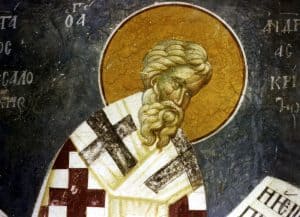
The Great Canon of St. Andrew of Crete speaks about the repentance of the soul and its difficult journey back to the Heavenly Father. St. Andrew wrote it toward the end of his life, after many years of spiritual struggle. He was born in Damascus, lived and served in Syria, Constantinople, and on the island of Crete. The canon reflects his own repentance, but expressed through the stories of the Old and New Testaments. A great theologian and hymnographer, St. Andrew is remembered most of all for this penitential canon, read every year during Great Lent.
According to tradition, St. Andrew was unable to speak as a child, but after receiving Holy Communion at the age of seven, he was miraculously healed. As a youth, he embraced the monastic life at the monastery of St. Sabbas the Sanctified. Later he became an archdeacon at Hagia Sophia in Constantinople. His holy relics were eventually brought to Constantinople, though he reposed on the island of Lesbos, serving the Church faithfully until his last breath.
Why It Is Called the “Great” Canon
The Canon of St. Andrew of Crete contains about 250 verses – lengthy in form and rich in meaning. It was originally written in Greek and later translated into Ukrainian; this is the version we hear in church today. Because many prostrations are made during its reading, some may find it physically demanding. But the true labor of the canon is spiritual, not physical. To understand its depth, it is helpful to read Holy Scripture, for the canon reveals the tragedy of sin and the pain of a soul wounded by it.
The Structure and Meaning of the Canon
The Canon of St. Andrew of Crete is divided into four parts. It is a profound poetic and theological work that prepares the faithful for the spiritual journey of Great Lent. Fasting is not merely about food – it is about repentance, prayer, and the healing of the soul. After each short verse, according to tradition, the faithful make a prostration. The canon is found in the Lenten Triodion and has been set to beautiful liturgical melodies sung in harmony.
When the Canon Is Read
During the first week of Great Lent, the Canon of St. Andrew of Crete is read over four evenings. The heart of Great Lent is the transformation of the human person through repentance. Without repentance, there is no spiritual life. True repentance requires honest self‑examination – a difficult but essential step in spiritual growth.
Many newly converted Christians – “neophytes” – come to the Lenten services and may find the long penitential prayers challenging. The canon speaks openly about the struggle of the sinful soul returning to God. In ancient manuscripts, the canon was read in different ways. The Church eventually divided it into four parts to help the faithful gradually enter into deep repentance. On Thursday of the fifth week of Great Lent, the entire canon is read again in full. By then, the faithful are spiritually prepared for a longer service. On this same evening, the Life of St. Mary of Egypt is read – a powerful example of repentance and holiness. The canon reminds us that God’s grace can cleanse every heart, even one deeply wounded by sin.
The Great Canon does not have to be read only in church – it may also be read at home. Prayer books as we know them appeared only in the 8th century; before that, Christians often prayed with such texts privately. If you cannot come to church, reading the canon at home is completely appropriate. And nothing prevents us from turning to this canon outside of Great Lent as well. True repentance and the desire to turn to God should live in the heart of every Christian at all times.
6 Inspiring Facts About the Canon of St. Andrew of Crete
The Great Penitential Canon is full of remarkable history. Did you know that it was not always read on the days we read it now? Or that it was not originally connected with Great Lent at all? And have you ever wondered how long church services lasted in the 7th century?
The Great Penitential Canon is full of remarkable history. Did you know that it was not always read on the days we read it now? Or that it was not originally connected with Great Lent at all? And have you ever wondered how long church services lasted in the 7th century?
- The Great Penitential Canon is only one of many works by St. Andrew of Crete. He wrote more than seventy canons for major Byzantine feasts.
- St. Andrew was not only a preacher and hymnographer but also a composer. The original melodies for the canon were written by him.
- St. Andrew is credited with creating the nine‑ode structure of the canon — a new form of liturgical poetry that replaced the older kontakion. Services in those days were much longer, and the Great Canon was not even his largest work. In the same century, the form of the Six Psalms (Hexapsalmos) also took shape, and the entire Psalter was often read during services.
- Until the 14th century, the Church in Rus’ followed the Studite Typikon, which appointed the Great Canon to be sung during the fifth week of Lent. Sometimes it was divided; sometimes it was read in full. The practice of reading it in four parts during the first week comes from the Jerusalem Typikon, which the Church later adopted.
- Originally, the Great Canon was not connected with Lent at all. Some scholars believe it was St. Andrew’s personal confession near the end of his life, written as repentance for his participation in the false council of 712. Although he later repented publicly, the memory of that event deeply troubled him — and the canon became his great poem of repentance and return to God.
- The four parts of the canon read during the first week of Lent are called “mephymnia” in Greek.


LEAVE A REPLY